How to read the inspector
The panel at the foot of every page has up to ten sections, and each one answers a different question about where a number came from. Here is what each of them says, and what this site had to do to be able to say it.
By Douglas Lovell with Claude Opus 5 (Anthropic)
Every page of this demonstrator ends with an inspector.


Expanding the inspector shows every number behind the metering of this page, each one read from an account on the public chain. The inspector exists for a technical person evaluating the sol-pay on-chain metering capability that this site demonstrates.
The order
The inspector displays the most-changing data above the more static data.
- The values, in full: the key to every short name below. Above the gradient, changed or not.
- Preflight: changes on every request. The site's own arithmetic over the accounts read for this request.
- The last transaction: present only on a request that sent one. The instruction as the sol-pay client library built it, not as the chain returned it.
- Your meter, on chain: changes when the reader is charged. This site's count against the reader's fund.
- Your fund, on chain: changes when a settle draws on it, or when the reader adds to it. The reader's money, which other sites may meter on too.
- Your wallet: seldom changes. The wallet that the fund names.
- The treasury: changes when a settle lands. The on-chain account of the site's income from readership.
- Configuration drift: shown if configuration diverges from the site account.
- Site account: read from the chain on this request. First-run setup wrote it, and nothing writes it again.
- Deployment: never changes.
The three sections about the reader appear only for a browser that holds a meter.
The values, in full
This is mostly an address table. Base58 is unreadable, and worse than unreadable it is comparable-looking: two addresses that share four leading characters read as the same address to an eye scanning a panel. So every long value the panel shows gets a short name — a role prefix and a nonsense syllable. This table is where the short name is introduced beside the thing it stands for.
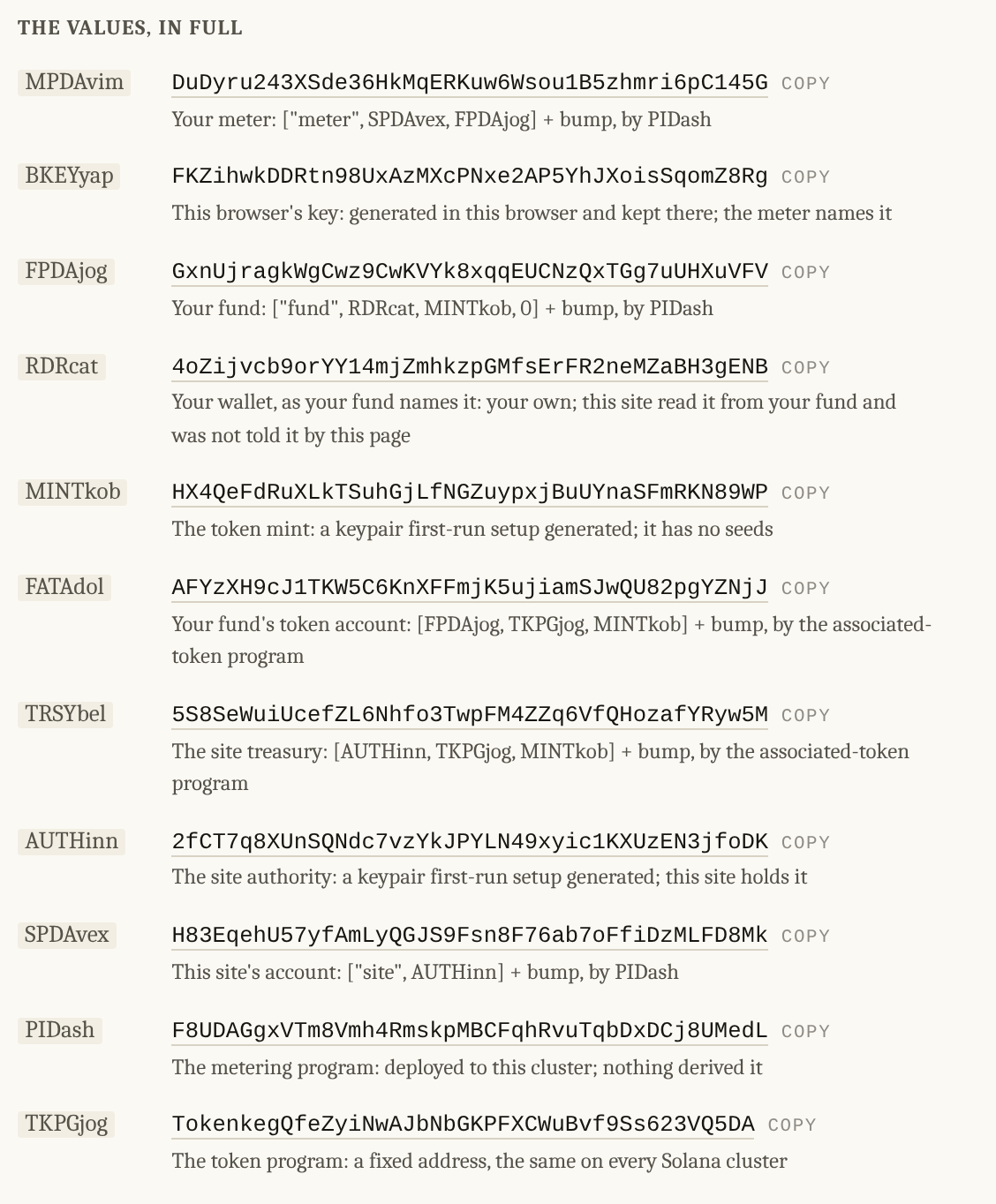
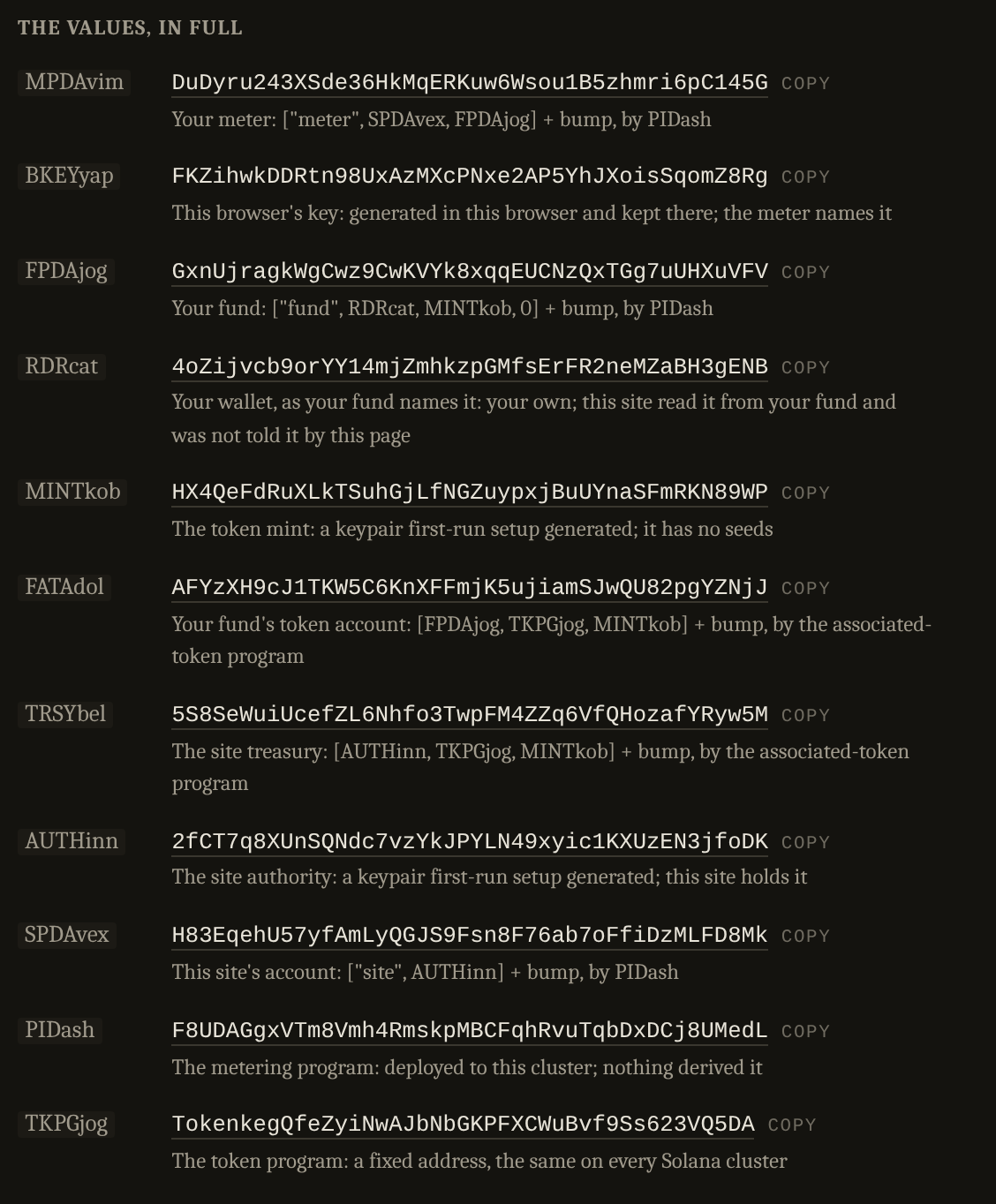
The short names are this site's invention and mean nothing to a wallet or an explorer. The full base58 is always one click away and always what gets copied.
Everywhere else in the inspector, a long value is written as its short name alone, linked to its row here.
The explanations
Under each value is a description of what it represents and how it is derived.
Three of these addresses are derived by the sol-pay metering program. The
site account comes from ["site", AUTH…]. The reader's fund comes from
["fund", RDR…, MINT…, index]. The meter comes from
["meter", SPDA…, FPDA…]. Each has the bump that made it land off the curve.
The seeds are written in short names, so every seed names another row of this
table.
Two more are derived by Solana's associated-token program, which this site did not write and does not own: the treasury and the fund's token account.
The rest were never derived, for different reasons. The mint and the site authority are keypairs that first-run setup generated. The browser's key was generated in the reader's browser. The reader's wallet is the reader's own. The metering program has the address it was deployed to. The token program's address is a constant that every Solana cluster shares.
Preflight, for this request
Displays five answers the site works out for itself before it sends anything, each with the on-chain program check the answer mirrors written underneath.
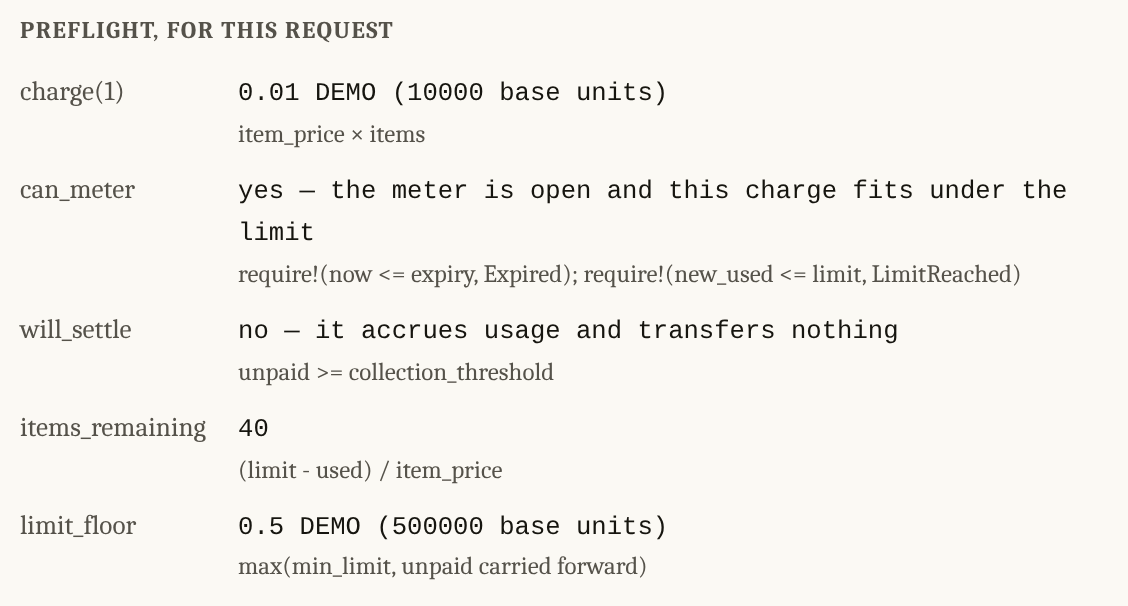
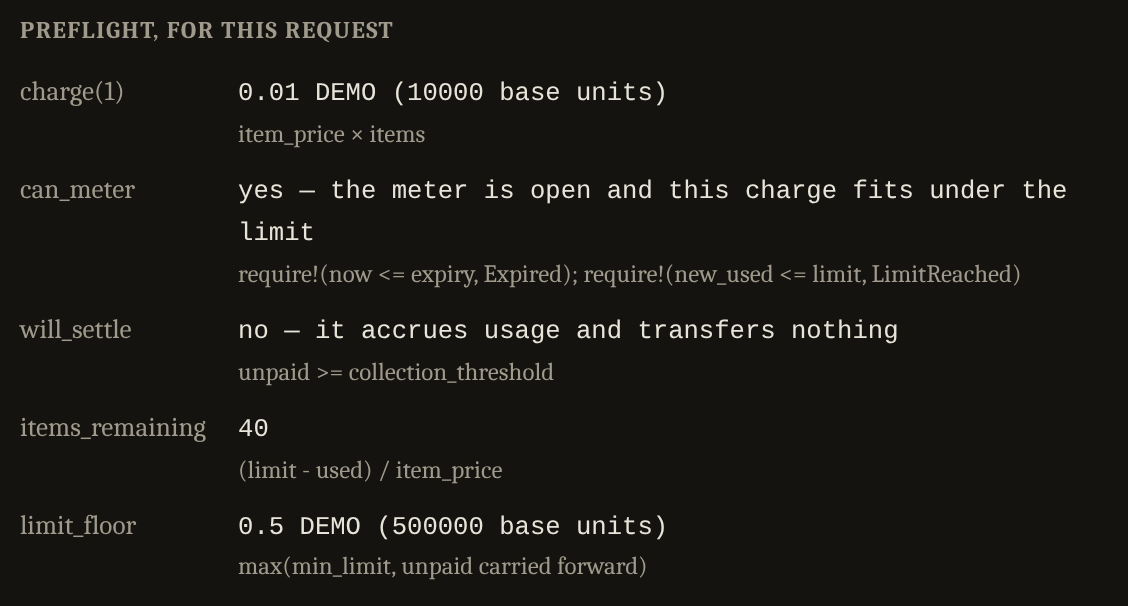
The preflight saves the server a round trip. The endpoint the server queries will simulate a transaction before forwarding it. A call the on-chain program would refuse is usually rejected there, never included in a block, and costs nothing.
A fee is charged when a transaction lands and then fails. Failure implies that the accounts moved between the simulation and the call: another site's settle drew down the same fund, or the reader's wallet withdrew from it, in the gap. The fee is the site's fee either way. The site authority signs every metering call and pays for it. The site pays for the close too. The only transactions the reader pays for are the ones the reader's wallet signs: the setup, a renewal and a deposit.
The mirroring is the point, and it is also the risk. The client library's arithmetic is a copy of the program's, made because a web server cannot call into a Solana program to ask. A copy can drift. The library's own documentation says so and names the conformance run that pins it. This section adds the other direction: a reader who trusts neither can take these five answers, compare them against the account fields, and do the arithmetic themselves.
These are predictions, not decisions. The program checks every one of them again. The on-chain program's answer is the answer that charges. Where the two disagree, the program is right and the server view has diverged.
One of the five can disagree honestly. can_meter asks whether the meter has
expired by this server's clock, and the program reads the cluster's clock.
Near the expiry the two answers differ by however far apart the clocks are.
After a close there is no meter. Three of the five have nothing to answer against, and they say so.
The last transaction
The transaction this request sent, and the instruction that went into it.
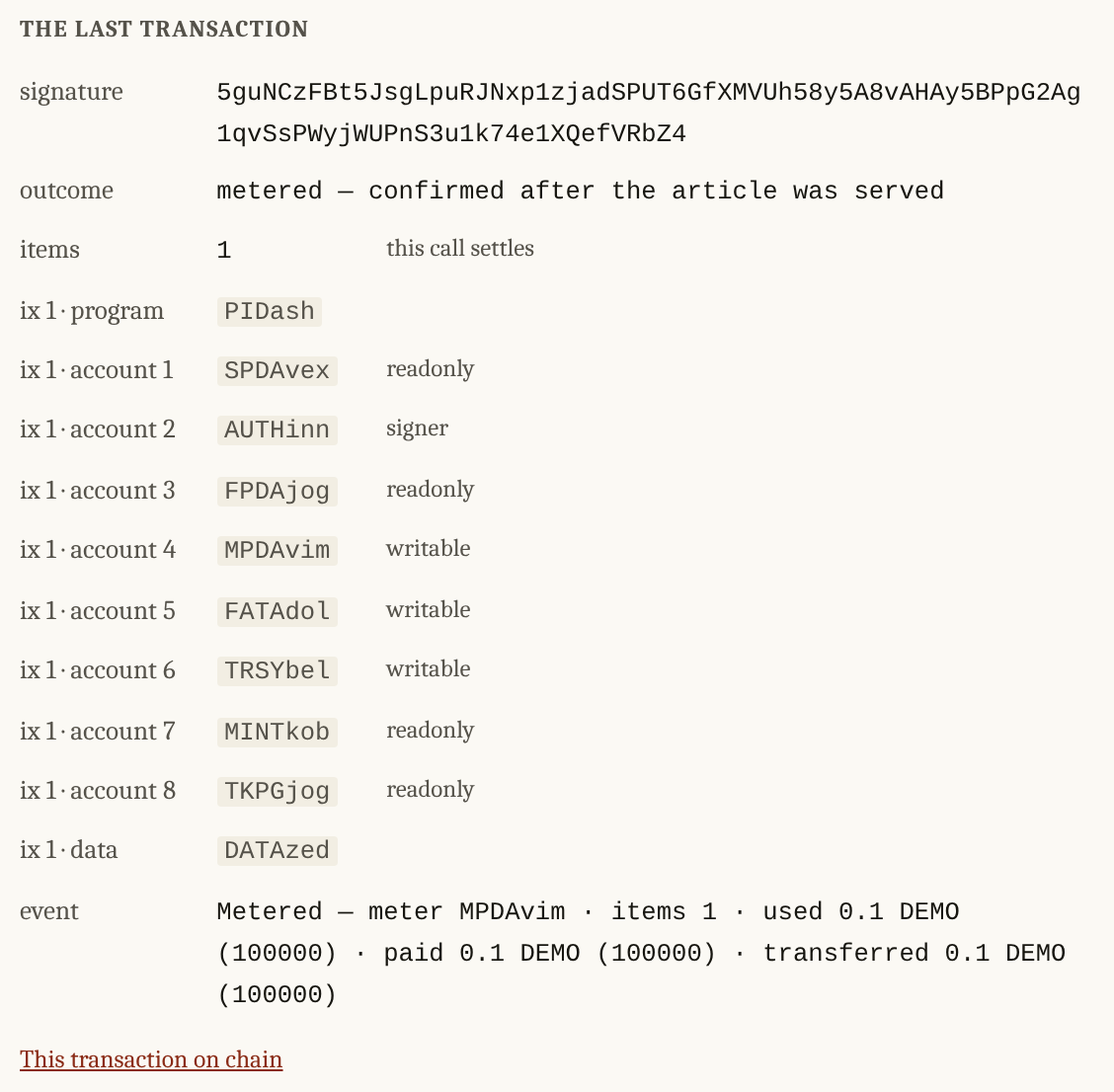
A charge is one instruction of the metering program, meter_and_settle.
This site's web server does not assemble that instruction by hand. The web
server calls the sol-pay client library, the PHP package that knows the
metering program's account order and byte layout, and the client library
returns the instruction. These rows show what the client library returned:
the program, the accounts in order with their signer and writable flags, and
the data bytes. The first eight data bytes are the Anchor discriminator,
sha256("global:meter_and_settle") truncated. The rest is borsh.
The web server puts the instruction into a transaction without changing it. That is what makes this section a check on the client library, not a description of it.
The site serves an article as soon as the endpoint accepts the charge, and a later request asks whether the charge landed. Two orderings that disagree on purpose explains why. Only the request that built the instruction ever holds it. So the page keeps the instruction rows in place when the later answer arrives, and the outcome row changes above them.
"Last" means this request's. That is a consequence of what the site refuses to keep. A charge's signature is kept with the grant that the charge bought, for about half an hour, so that a later request can ask whether the charge landed. Beyond that there is no list of a meter's calls anywhere in this system, because a list like that is exactly the reading history the design exists not to hold. On a page that sent nothing the section is absent, not empty.
The close
Closing the meter is the other transaction this site sends. The browser's key signs the close and the site authority pays the fee.
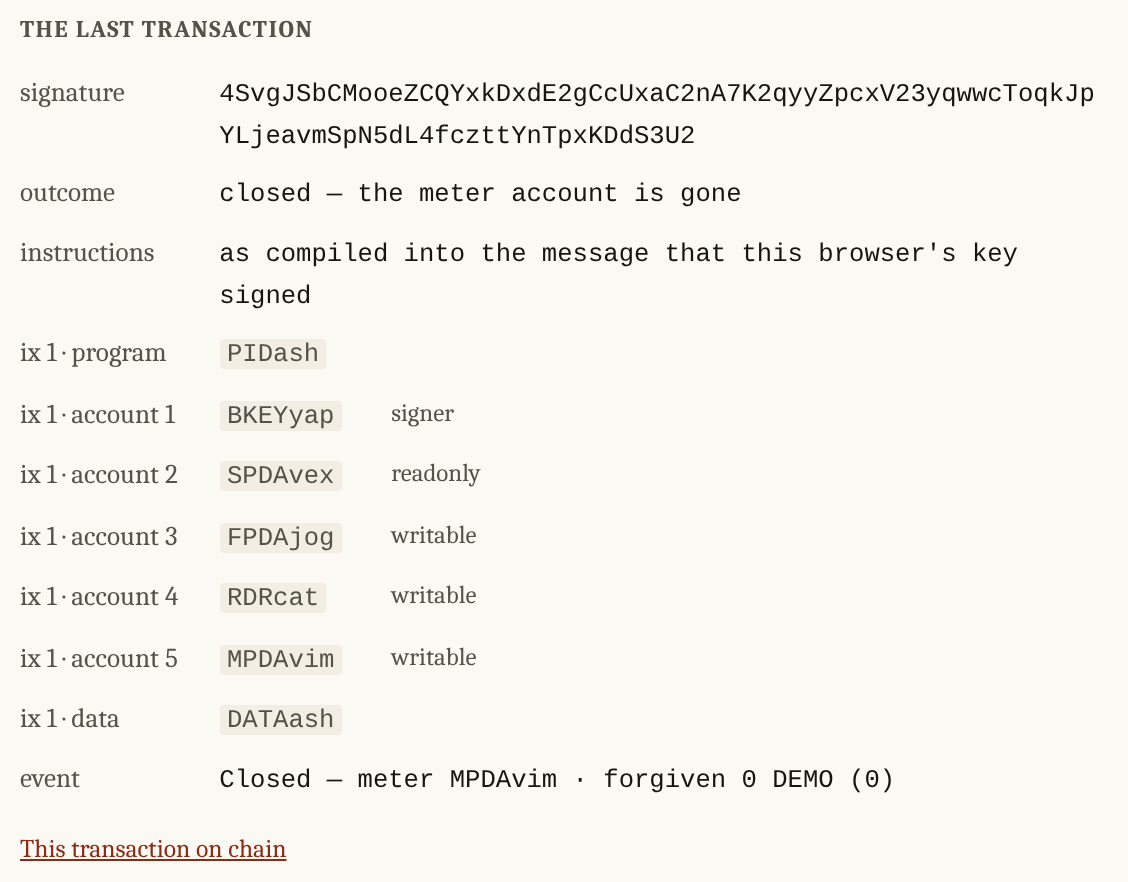
The outcome row reports an account, not a signature. After the site sends the close, the site reads the meter's address. The meter being gone is the evidence that the close landed. That one read also fetches the fund and the site's accounts. So the panel shows the accounts as the close left them, and the close pays for no extra round trip.
The instruction rows have a different source here, and a row says so. One request composes the close for the browser's key to sign. The next request sends the signed close. The compiled message is all the site keeps between the two requests. So the rows are read back out of the message that the key signed. Building the instruction a second time for display would prove nothing: a panel that rebuilt the instruction would agree with itself whatever had been sent.
What the wallet sends is not here
The setup, a renewal and a deposit are the reader's transactions. The site composes each one when the wallet asks for it, and the wallet signs and submits it. The site sends none of them, so none of them is ever the last transaction. Your wallet, below, is where the panel says that one has happened.
The row that fills in when the inspector opens
The event row arrives saying it has not been read yet, and then reads
itself.
Decoding the program's own Metered, Renewed or Closed event needs a
getTransaction call. That would be one more round trip on every charge.
Rather than spend it on every metered view, the panel asks a small endpoint
for it when the inspector is expanded, and once. The answer cannot change for
a landed signature.
Without JavaScript the row keeps the sentence the server put there, which stays true rather than becoming a spinner that never resolves.
The small endpoint holds no session and nothing that is privileged. The transaction signature is public. Every byte it returns is readable by anyone holding the same signature and an explorer. It is not a history lookup. It answers about the one signature it is handed.
Your meter, on chain
This site's count against the reader's fund, read back from the chain.
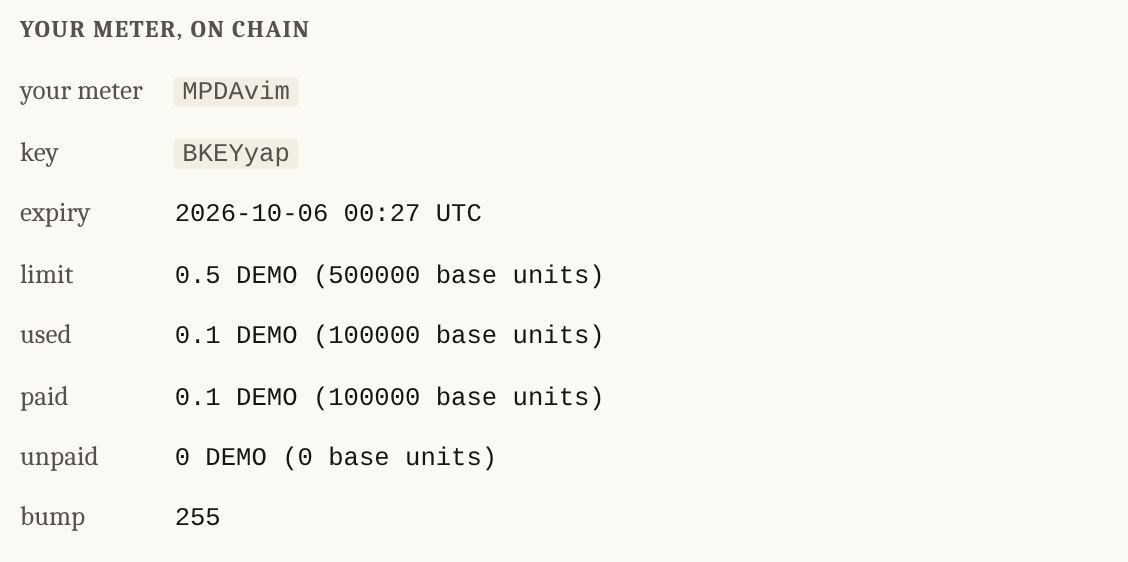
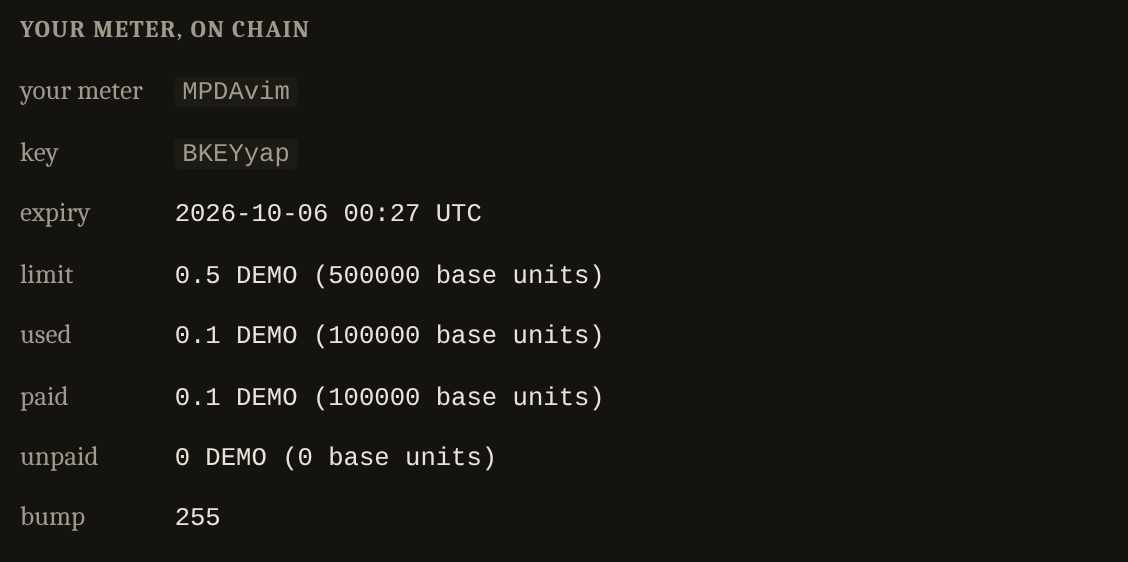
The key and the expiry are the rows that matter. The key says which browser the meter answers to. The site reads the meter on every request, and a meter that names another key ends this browser's session. A renewal from another device does exactly that. The ID of what's paying explains why a key in the browser stands where a sign-in page would.
The expiry bounds what a meter left behind on a machine can cost, whatever happens to the machine. After the expiry the program refuses every charge. What the limit promises covers the limit and the expiry together.
Below them: the limit set, how much has been used against it, how much has actually been transferred, and the difference.
Your fund, on chain
The reader's money, and the account that holds it.
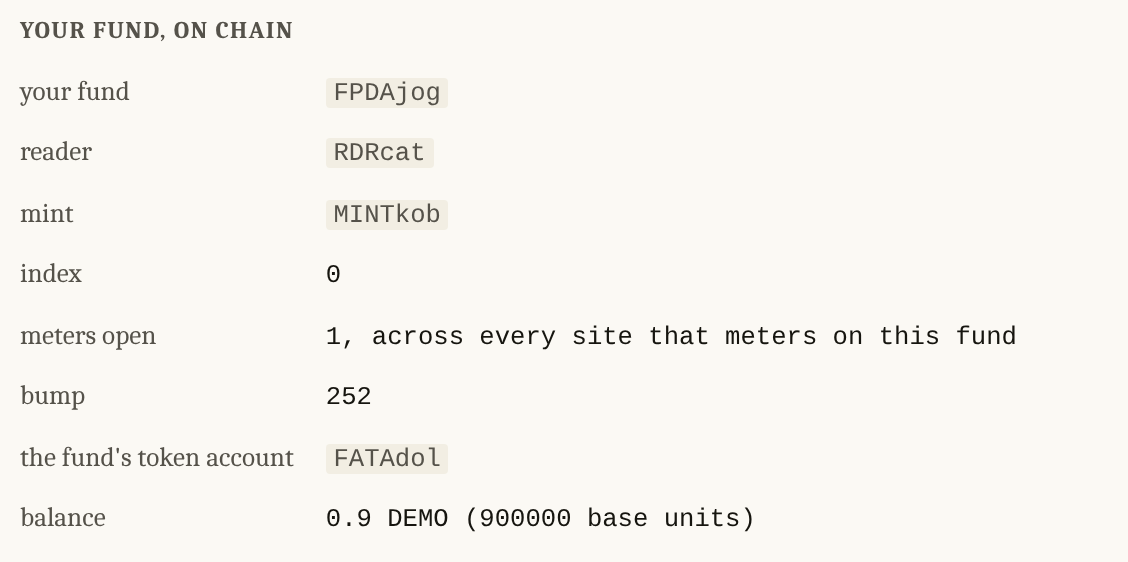
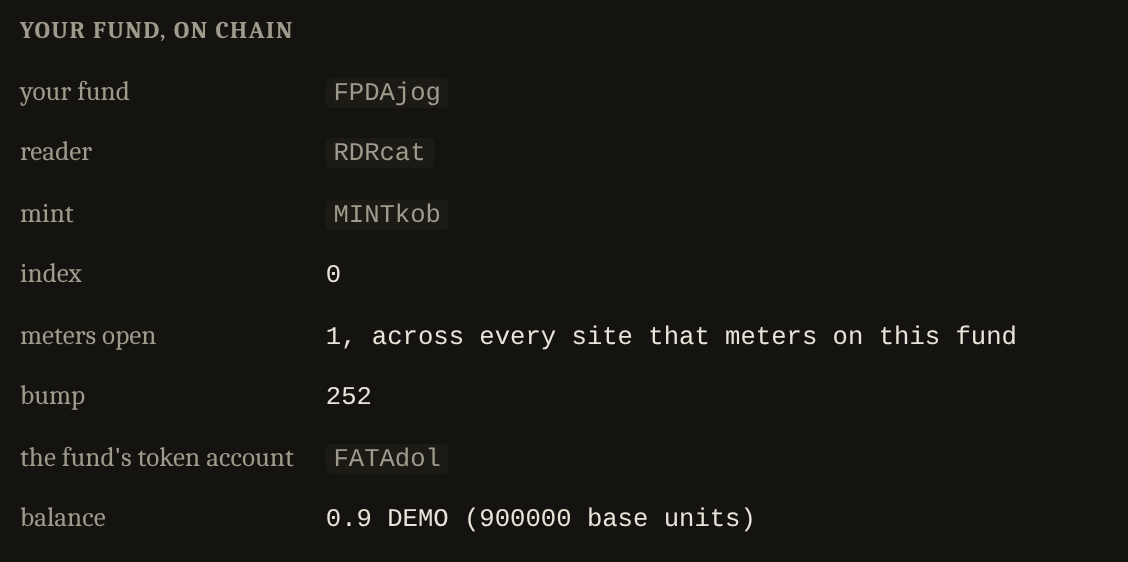
The meter and the fund are two sections because they are two accounts. The
meter is this site's. The fund is the reader's, and any site that uses the
metering program can open a meter on it. meters open counts those meters
across every such site. It is the one figure in these sections that is not
about this site.
The balance is not a field of the fund. The money sits in the fund's token
account, an associated token account that the fund itself owns. A settle
draws on that account, and the metering program signs the transfer with the
fund's seeds. So the address to open in an explorer for the balance is the
token account's, FATA in the values table.
Your wallet
The wallet that the fund names, and what that wallet last did.
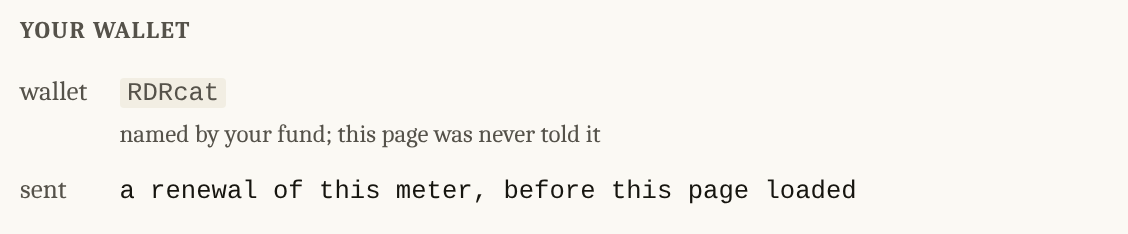
The heading does not say on chain, and the omission is deliberate. The site reads nothing from the wallet's own account. The page never asks which wallet the reader holds. The fund records its reader, and the fund is public, so the panel can show the wallet and say where the panel learned it.
The sent row is the only row in the inspector that the server does not
know. The wallet submits its own transaction. No request the site serves
afterwards can tell that a setup, a renewal or a deposit has just gone. The
browser can tell, because the reader pressed continue there. The browser
carries one word to the next page, and the panel shows the matching row. The
server wrote the row's words into every panel, in an element that displays
nothing until the browser picks a row. The server is not told which row was
picked, and stores nothing.
The row lasts one page. A reload loses the row, as a reload loses a charge's instruction rows. No signature is shown, because the wallet sent the transaction and the site did not see it. The result is in the two sections above: a new expiry on the meter, or a larger balance in the fund.
Treasury
What readers have paid so far, on this deployment.
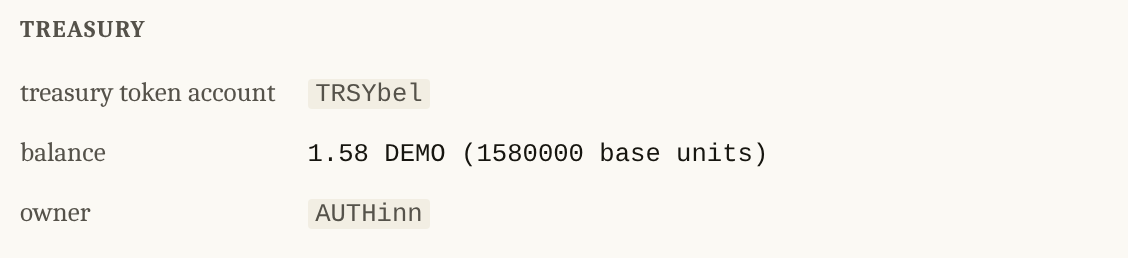
The treasury is a derived address rather than something setup created. It is the site authority's associated token account for the mint. The provisioner computes the address before anything exists there. That is an easy one to get wrong. The TRSY line in the values table names the program that derives it.
Configuration drift
This section is an alarm that seldom sounds.


The site's prices live in a config file. That config decides what first-run setup writes on chain. After that the chain is the authority and nothing reads the config for a price again. Editing the config file afterwards changes nothing. The site is initialised once. The only visible consequence will be a source file that disagrees with the running site.
When the two disagree, this section appears and says so, in both numbers. It sits directly above the account it is disagreeing with, so the claim can be checked one section later.
Site account, decoded
The account this site runs on, field by field.
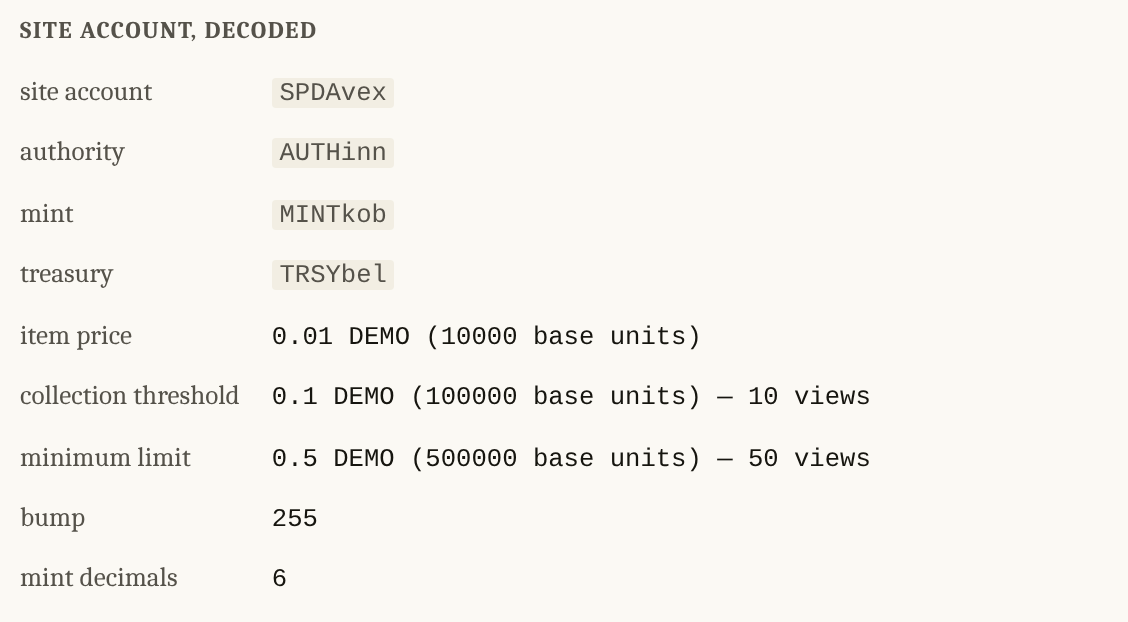
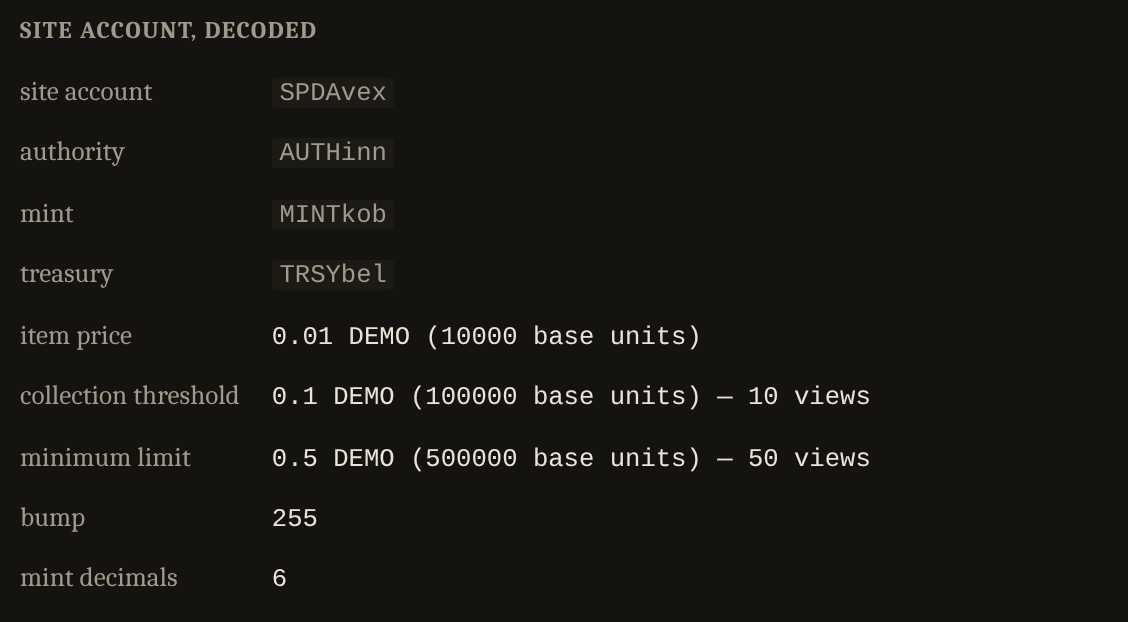
Read from the account on this request. The fields are in the order and sizes the client library's specification lays them out in (wasm-client/SPEC.md §6.2). It is itself a check, since a field read at the wrong offset would show up here as a number that makes no sense, rather than as silence.
Every amount appears twice, as a decimal figure and as base units. A six-decimal scaling error — turning 50 into 50,000,000, or the reverse — is invisible until the two forms sit side by side. The library specification explicitly warns about it. The decimal figure is computed at the decimals the mint itself reports, not at the decimals the config assumes.
The collection threshold and the minimum limit also say what they are in views, because a threshold quoted only in tokens is a number nobody can act on.
Deployment
Four things. They never change.
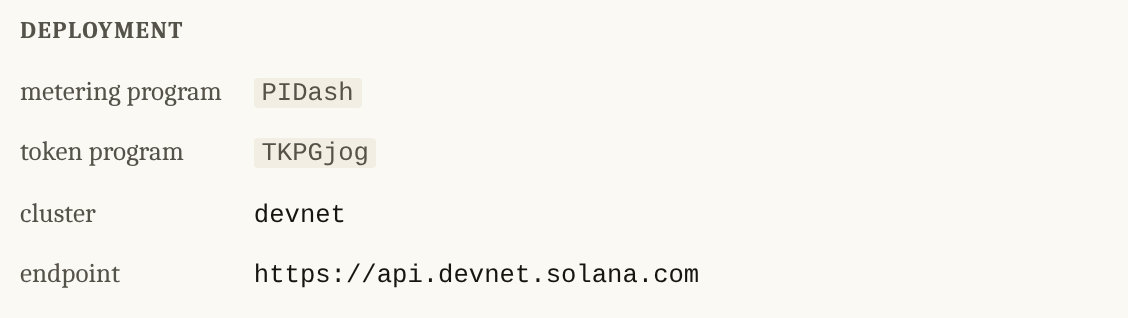
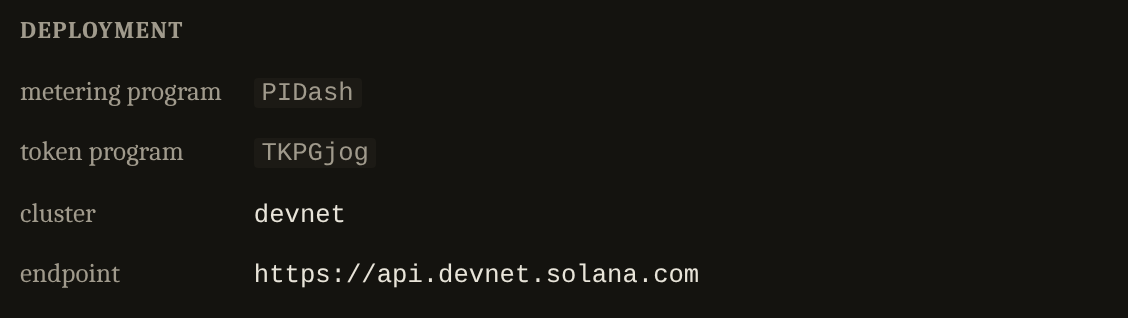
- which program does the metering
- which token program it uses
- which Solana cluster this is running
- which RPC endpoint this calls.
The endpoint is on screen for a reason that is easy to miss. It is called by this server and never by the browser. An RPC provider that saw the browser would learn an IP address to match with a meter, on every page view. This is precisely the profile this site is built not to produce.
Seeing only this server, the provider learns only that one server asked about some accounts.
A copy run for development adds a row here when the development wallet is on. That wallet signs a setup in place of a phone, so the row is there to keep anything done with it from being mistaken for a reader's wallet.
When the panel has nothing to show yet
On a page that had no reason to touch the chain, the panel opens onto a sentence and a link instead of onto sections.


The cold call
Here is something this implementation measured as well as reasoned. Filling
the inspector costs one getMultipleAccounts call to read the accounts it
displays.
The inspection panel is rendered on every page, so every page — the privacy page included — would block on an account read to fill a panel that is collapsed by default. On the privacy page that one call was the page load: 0.899 seconds, on a page that displays nothing from the chain at all. Without it, the page load is two milliseconds. The rule is not defer the panel. It is defer the read nothing else needs.
Where a request has already read the chain for its own reasons — the article's POST, where the metering decision cannot be made without reading — the panel renders inline with the answer already in hand. It costs nothing extra, because the read was required work either way.
Rendering the panel from the POST's own read keeps The last transaction possible. That section needs a result that exists only on the request that produced it, and the result would not survive a deferred fetch. Under this rule it never has to. The close follows the same rule: the request that sends the close renders the panel for it.
The link in the deferred panel's paragraph is not decoration. Without JavaScript it is the panel: it goes to a page that renders the same sections server-side, from the same partial, so the fragment and the page cannot drift apart. Nothing about the inspector depends on a script to stay reachable.
Two other states are worth naming. When the chain cannot be read, the panel says so and the page is still served — nothing on this site depends on the chain being reachable until a charge has to be made. On a copy that has not been set up, the panel says what is missing and shows the configured prices instead, which are the only prices there are until something is written on chain.
What the panel is for, one more time
Every section above is the same argument in a different place: a number displayed without its source is a number the reader has to take on trust, and this site is trying not to be trusted.